What Happens When a Culture Loses Its Foundations?
I hope you love the products and resources I recommend here at Foundational. It is possible that I get a commission and collect income from the links on this page. Click here for more info.
When truth becomes subjective and biblical foundations are removed, what can the righteous do?
There was a time when the phrase “when pigs can fly” was an easy way of saying that something was impossible.
But what happens when a culture begins losing its ability to recognize what is true and what is false?
What happens when foundational beliefs about truth, morality, human identity, education, and faith are continually challenged or redefined?
These are the questions I hope to tackle in this episode of Foundational U.
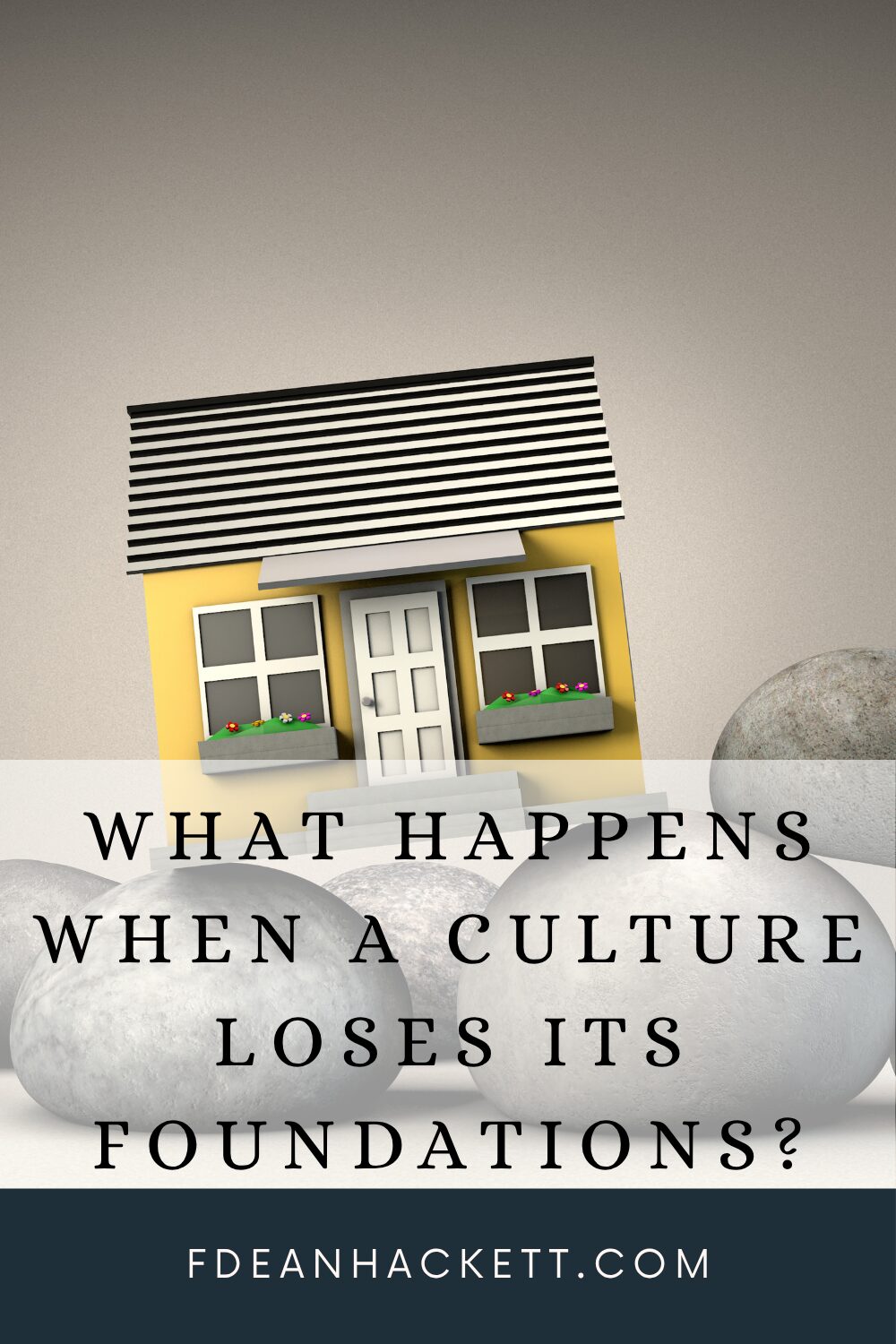
And he begins with a sobering question from Psalm 11:3
“If the foundations be destroyed, what can the righteous do?”
Watch the Teaching

When the Foundations Begin to Crumble
Every healthy society needs foundations.
There must be some agreed-upon standard for determining truth, morality, right and wrong, and what is good for human flourishing.
But when those foundations are removed, confusion follows.
Dean points to the increasing difficulty many people have in distinguishing between truth and distortion. He argues that when society abandons objective truth, people can begin accepting ideas that previous generations would have considered unthinkable.
The problem isn’t simply that people disagree.
The deeper problem is that the standard for determining truth has been removed.
And when there is no longer an objective standard, everyone can create their own version of reality.
There Is No Such Thing as “My Truth” and “Your Truth”
One of the central points of this episode is that truth doesn’t change depending on who believes it.
If something is true, it remains true regardless of the person, culture, or generation.
The idea that everyone can have their own personal version of truth sounds appealing, but it creates an obvious contradiction.
If two opposing claims are both called “truth,” then neither can actually function as an objective standard.
Truth must stand outside of our personal preferences.
And for the Christian, that foundation is ultimately found in God and His Word.
What Happens When Truth Is Removed?
Dean describes a dangerous progression.
When people embrace lies, those lies can become accepted as normal.
Distortion follows.
Deception becomes easier to believe.
Eventually, people can begin calling good evil and evil good.
Right becomes wrong.
Wrong becomes right.
And once the foundational framework for truth has been removed, destructive ideas can enter a culture without being recognized as destructive.
That’s why this isn’t merely an intellectual discussion.
Truth has consequences.
So does rejecting truth.
The Church Must Not Be Shaped by Culture
Perhaps one of the most important challenges in this episode is Dean’s call for Christians to stop allowing the culture to determine what the Church believes.
Jesus called His followers to be salt and light.
Salt influences.
Light exposes darkness.
The Church was never supposed to disappear into the culture or simply reflect whatever ideas happen to be popular at the moment.
We are called to influence the culture rather than allowing the culture to influence the Church.
That requires Christians who are willing to know God’s Word, believe God’s Word, and live according to God’s Word.
We Have Been Entrusted With the Truth
Dean also points to Jude’s command to believers to “contend earnestly for the faith which was once delivered to the saints.”
That phrase carries tremendous responsibility.
The Christian faith isn’t something we are free to continually reinvent.
There is a body of truth that has been entrusted to the Church.
Our responsibility is to protect it, teach it accurately, live it faithfully, and pass it on to the next generation.
That doesn’t mean being argumentative.
It doesn’t mean being unkind.
And it certainly doesn’t mean treating people without love.
It means refusing to compromise biblical truth simply because that truth has become unpopular.
Truth Must Be Spoken With Love
There is an important balance here.
Christians are called to speak truth—but with love.
We don’t need to become angry or hostile toward people who disagree with us.
We don’t need to demean people.
We don’t need to win arguments for the sake of winning arguments.
But love doesn’t require us to call falsehood truth.
We can love people deeply while remaining firmly committed to what God’s Word teaches.
Truth without love can become harsh.
Love without truth becomes compromise.
Jesus demonstrated both.
What Can the Righteous Do?
So we come back to the question from Psalm 11:
“If the foundations be destroyed, what can the righteous do?”
We can stand.
We can pray.
We can know God’s Word.
We can teach the truth to our children.
We can refuse to compromise our convictions.
We can speak truth with love.
We can become the light Jesus called us to be.
And we can trust God even when the culture around us seems increasingly confused.
The answer isn’t to panic.
The answer isn’t to retreat.
The answer is to become exactly what Jesus called His disciples to be.
Faithful.
Bold.
Salt.
Light.
The Next Question
This episode ends with an important question that sets up the next teaching in the series:
How do we discover truth—and where do we find it?
That’s an essential question for every Christian living in a culture where competing voices are constantly telling us what to believe.
If truth matters, we need to know where truth comes from.
And if God’s Word is our foundation, we need to know how to build our lives firmly upon it.
Listen to the Podcast
Take this teaching with you while you’re driving, walking, working around the house, or simply spending time thinking through the issues facing our culture today.
Final Thought
A culture doesn’t lose its foundations all at once.
Foundations are weakened one compromise at a time.
That’s why Christians cannot afford to become careless about truth.
We have been entrusted with something precious.
The faith once delivered to the saints.
Our responsibility is to guard it, live it, teach it, and pass it faithfully to the next generation.
The culture may change.
Truth doesn’t.