Who Destroyed the Foundations of Our Culture?
I hope you love the products and resources I recommend here at Foundational. It is possible that I get a commission and collect income from the links on this page. Click here for more info.
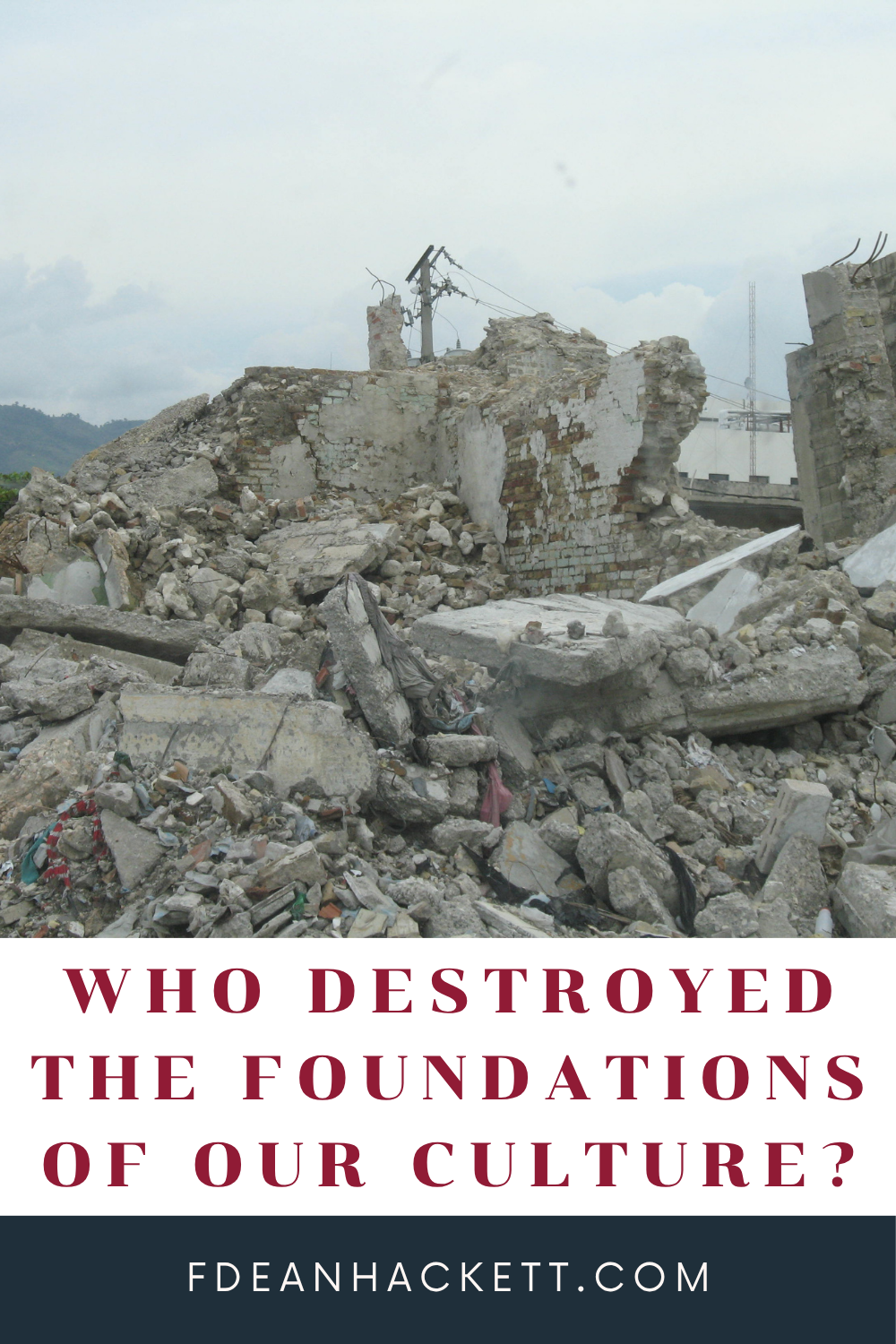
A house can look impressive from the outside while termites quietly eat away at the structure underneath. For a while, nobody notices.
The walls still stand, the roof still covers the house, and everything appears normal. Then one day, something gives way, and everyone wonders how the damage happened so quickly.
I believe we’re seeing something similar happen in our culture.
We can look at America and see tremendous technology, advanced medicine, universities filled with educated people, sophisticated legal systems, political institutions, churches, families, and communities.
Yet underneath all of those structures, the foundations have begun to crumble. We’re seeing confusion about identity, morality, truth, human purpose, family, education, science, and even the authority of Scripture.
The question isn’t simply, “What’s wrong with our culture?”
The deeper question is, “What happened to the foundation?”

When a Culture Loses Its Answers
Every human being eventually asks the same fundamental questions.
How did I get here? Who am I? Why am I here? What is my purpose? What is right and wrong? Does anything have absolute moral value? Is this life all there is, or is there something beyond the grave?
Those questions don’t belong only in a philosophy classroom. Every person has to answer them because the answers shape the way we live.
When a young person doesn’t know where human life comes from, that person struggles to understand human worth. When there is no objective answer to the question of right and wrong, morality becomes a matter of personal preference. When identity comes entirely from feelings, identity becomes unstable because feelings change. When life has no purpose beyond existence, despair can easily take hold.
I’ve watched our culture struggle with these questions for years, and I believe one of the most dangerous developments has been the rise of postmodernism and deconstructionism.
The damage hasn’t stayed inside university philosophy departments.
It has moved into the culture.
What Is Deconstructionism?
Postmodernism developed partly as a reaction against modernism and the Enlightenment emphasis on rationality and reason. Postmodern thought increasingly placed greater emphasis on individual perspective, personal experience, emotion, and what each person considers real.
Deconstructionism takes that further by questioning the foundations themselves.
Instead of accepting established ideas, traditions, definitions, institutions, and systems as having authority, deconstruction asks that they be taken apart and reevaluated. The old structure gets dismantled, and then someone decides what should replace it.
That sounds appealing until we realize that some things cannot survive without a foundation.
If every truth must continually be dismantled, questioned, reconstructed, and redefined, eventually nothing remains solid enough to support the structure.
That’s exactly what concerns me about what we’re watching in our culture.
The termites have moved into the foundation.
When Everything Becomes Subjective
Once a culture loses the idea that some truths exist independently of our feelings, people lose the ability to distinguish between what is true and what merely feels true.
That creates enormous problems.
Consider morality.
Science can tell us what happens when we perform an action, but science cannot tell us whether that action is morally right. Biology can describe the human body, but biology cannot establish the ultimate moral value of human life.
Sociology can study human behavior, but sociology cannot determine whether a particular behavior is righteous or sinful. Law can establish rules for society, but lawmakers themselves need a standard by which they determine whether those laws are just.
- Medicine can’t give us morality.
- Philosophy can’t give us morality.
- Education can’t give us morality.
- Law can’t give us morality.
The only reliable source for absolute morality is the Word of God.
That’s why the battle over the authority of Scripture matters so much.
If the Bible loses its authority, where does a culture turn for an objective standard of right and wrong?
“If the Foundations Be Destroyed”
David asked a question in Psalm 11:3 that sounds remarkably relevant to the crisis we’re facing:
“If the foundations be destroyed, what can the righteous do?”
That question assumes something important: foundations matter.
A building cannot stand indefinitely when someone removes the foundation beneath it.
The same principle applies to a civilization.
If a culture removes the foundations of objective truth, moral absolutes, human dignity, family, responsibility, and accountability before God, it shouldn’t surprise anyone when the structures built upon those foundations begin to weaken.
We’re watching that happen in real time.
Definitions that once seemed obvious have become controversial. Questions about human identity have become battlegrounds. Moral standards that previous generations considered foundational are now treated as personal preferences.
Institutions that once operated from shared assumptions increasingly disagree about what those assumptions should be.
The problem goes much deeper than politics.
The problem concerns what we believe is true.
Jesus Gave Us the Answer
Jesus addressed the issue of foundations in Matthew 7.
He described two people building houses. One built on the rock, while the other built on sand. Both houses eventually faced rain, floods, and wind. The difference wasn’t whether the storm came. The storm came to both.
The difference was the foundation.
Jesus said the person who hears His words and does them resembles the wise builder who established his house upon the rock. The person who hears His words but refuses to do them resembles the foolish builder who built upon the sand.
That teaching reaches far beyond an individual’s private spiritual life.
It gives us a principle for everything we build.
- A marriage needs a foundation.
- A family needs a foundation.
- A church needs a foundation.
- A society needs a foundation.
- A civilization needs a foundation.
And Jesus tells us where that foundation must come from: hearing His words and doing them.
The Church Cannot Build on Shifting Sand
This is where I believe the church carries enormous responsibility.
The answer to cultural confusion isn’t for the church to become more culturally acceptable. The answer isn’t to soften every difficult biblical teaching until nobody feels uncomfortable. The answer isn’t to replace biblical preaching with motivational speeches that make people feel better for thirty minutes but never teach them how to live.
The church needs solid biblical preaching.
That means preaching the text of Scripture faithfully. It means teaching people what the Bible says, explaining what it means, and showing them how to apply it to daily life.
People need to know how God’s Word applies when they’re facing adversity.
They need to know how God’s Word applies when their marriage is struggling.
They need to know how God’s Word applies when their children are making destructive decisions.
They need to know how God’s Word applies when tragedy comes.
They need to know how God’s Word applies when the culture tells them one thing and Scripture tells them another.
Biblical preaching doesn’t simply fill someone’s head with information.
It teaches people how to build.
We Need More Than Head Knowledge
There is another part of this foundation that we cannot ignore.
We need the Word of God and the work of the Holy Spirit together.
Paul prayed for the believers in Ephesus that the eyes of their understanding would be enlightened. The Holy Spirit brings conviction, revelation, understanding, and power to the Word of God.
We don’t need Christianity that consists only of intellectual agreement.
We need people who know the Word of God and actually live it.
The Holy Spirit takes the truth of Scripture and brings it into the heart. He convicts us when we’re wrong. He gives us understanding when we struggle to see what God is saying. He strengthens us to obey when obedience costs us something.
The Word gives us the foundation.
The Holy Spirit gives us the power to live upon that foundation.
That combination can transform a life.
And transformed lives can transform families, churches, and communities.
We’ve Seen This Battle Before
This isn’t the first time the church has faced an attack on biblical authority.
In the late nineteenth and early twentieth centuries, higher criticism challenged traditional Christian views of Scripture. The church faced serious pressure to reconsider the authority, inspiration, and reliability of the Bible.
Yet God raised up men who stood firmly for biblical truth.
The podcast points to leaders such as Billy Graham and Carl F. H. Henry, along with the rise of the Pentecostal movement and later charismatic renewal, as examples of movements that strongly emphasized the authority of Scripture and the work of the Holy Spirit.
The lesson for our generation is clear.
The church cannot afford to surrender the foundation.
The Answer Is Restoration
So where does that leave us?
It leaves us with a responsibility.
We need to restore the foundation.
That restoration begins with a renewed commitment to the uncompromised Word of God. Churches need pastors who aren’t afraid to preach Scripture faithfully. Christians need to know their Bibles well enough to recognize when cultural ideas contradict biblical truth. Families need to build their homes around God’s Word rather than whatever ideas happen to dominate the culture.
And churches need the power of the Holy Spirit working alongside the preaching and teaching of Scripture.
We don’t need to tear everything down simply because someone tells us that every old foundation must be questioned.
We need to determine which foundations came from God and build upon those.
Jesus already told us which foundation will stand.
Build on the Rock
The storms aren’t going away.
Every generation faces adversity, temptation, tragedy, confusion, and moral pressure. Jesus never promised that His followers would live in a world without storms.
He told us how to survive them.
Build on the rock.
Hear His words.
Do them.
That’s the foundation.
The cultural crisis we’re witnessing didn’t happen because one person or one political party destroyed everything. The deeper problem came as generations gradually abandoned the idea that truth exists outside ourselves and that God has the authority to define truth, morality, human identity, and purpose.
The termites have been eating at the foundation for a long time.
But destruction doesn’t have to be the final word.
Foundations can be restored.
Lives can be rebuilt.
Families can return to biblical truth.
Churches can recover biblical preaching.
And God’s people can once again build their lives on the solid foundation of His Word through the power of the Holy Spirit.
The direct takeaway is this: when the culture tears down its foundations, don’t build on the rubble. Return to the Word of God, hear what Jesus says, do what He teaches, and build your life on the Rock.
Listen on Spotify
Related Content:
Who Determines What is Truth?
How To Have a Love For the Truth
What Happens When Pastors Compromise the Truth
What Happens When the Church Rejects the Truth of God’s Word?
The Truth About Post Modern Freedom
Who Determines Truth?
4 Ways Post-Modernism Is a Complete Failure
The Reason Why Truth Is Not Relative
What Happens When Pastors Stop Preaching Truth?
A Truth You Can Trust
Foundational U Podcast: Ep 58 – The Reality of Evil
Foundational U Podcast: Ep 59 – The Angel of Light, a Very Real Devil
Foundational U Podcast: Ep 61 – Finding True North
Four Misconceptions About the Presence and the Glory of God
More about Pastor Dean
Subscribe to receive my blog posts and podcasts each week
My Books
My Bible Studies
Join the Leadership Development Institute
Join my online Bible study each Thursday evening at 7:00 PM PST. Email me for more information.
About F. Dean Hackett
Dr. F. Dean Hackett has served in full-time Christian ministry since October 1971. He has ministered throughout the United States, Canada and Europe, serving as pastor, conference speaker and mentor. He has planted four churches, assisted in planting 15 others and currently serves as lead pastor of Living Faith Church in Hermiston, Oregon. Dr. Hackett founded Spirit Life Ministries International in 2001 to facilitate ministries in Croatia and Bosnia Herzegovina and to open a training center for workers in those nations.